

How much do you need to retire?
When planning for retirement, it is natural to look for a specific amount that provides complete peace of mind. There is no magic number where all financial worry drops to zero, because life changes, economic conditions shift, and everyday living costs evolve.
A general guideline of 25 to 30 times your estimated annual retirement expenses can offer a practical way to quickly gauge your progress. It is not a fixed requirement or a sign that you are ready to retire. Income from a pension or other sources may reduce the amount your savings need to cover.
Base your target on expenses, not salary
Everyone’s retirement lifestyle will look different. One person may look forward to a simple routine in a quiet community, while another plans for regular international travel, hobbies, or community projects.
Because your circumstances are unique, basing your goal on a multiple of your projected expenses keeps your plan centered on what you actually need. Choosing between 25 and 30 times your annual expenses is primarily guided by your retirement timeline and withdrawal strategy:
- 25 times your annual expenses: This benchmark is commonly used for a traditional retirement timeline of about 30 years. It corresponds to an initial withdrawal rate of roughly 4.0%.
- 30 times your annual expenses: If you plan to retire earlier with an extended retirement horizon of 35 to 50 years, a benchmark of 30 times your annual expenses can provide an added buffer. A lower initial withdrawal rate of around 3.3% may help your assets last over a longer horizon.
Understanding withdrawal rates
Your initial withdrawal rate is the percentage of your retirement portfolio you withdraw in your first year of retirement.
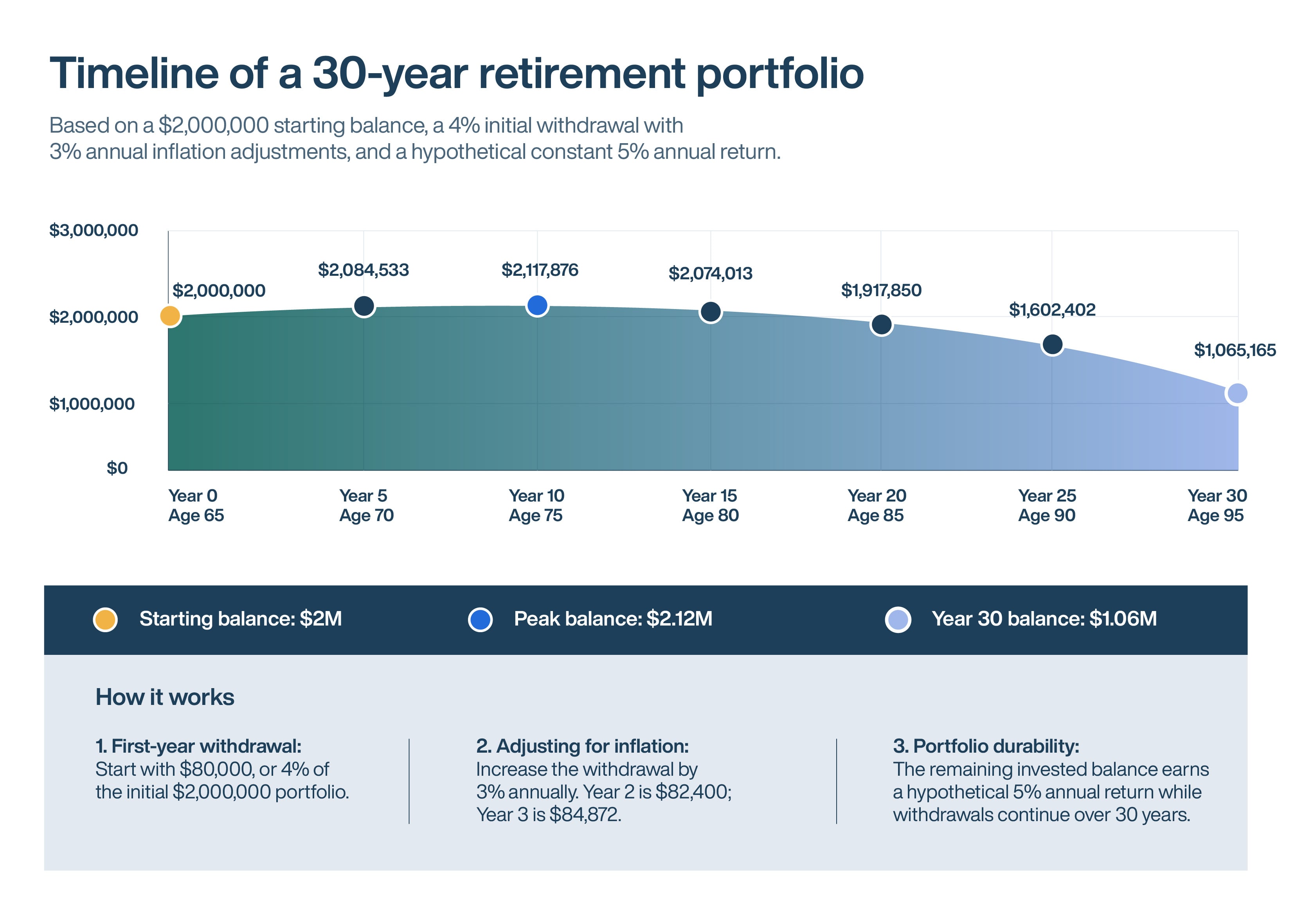
For example, if you enter retirement with a hypothetical $2,000,000 portfolio and select a 4% withdrawal rate, you will withdraw $80,000 in the first year (distributed monthly or quarterly to fund your day-to-day living expenses).
Under this approach, later withdrawals are adjusted for inflation rather than calculated as 4% of the remaining balance each year. For example, if there is 3% inflation, the second-year withdrawal would be $82,400 ($80,000 x 1.03). This illustrates one approach, not a recommendation. Amounts are shown in US dollars for illustration.
Money that remains invested may grow, but it can also lose value. How long your savings last depends on investment performance, inflation, taxes, fees, and your withdrawals. In this hypothetical example, at an average inflation rate of 3% and a 5% annual growth rate, a 4% initial withdrawal rate is designed to comfortably support your living expenses for 30 or more years.
Estimate a retirement savings amount
You can estimate your baseline target using four steps:
- Estimate your annual retirement expenses: Calculate what you realistically need each year to fund your desired lifestyle, including housing, healthcare, hobbies, travel, and estimated income tax.
- Estimate income from pensions and other sources: Check whether you will receive income from an institutional pension (such as the UNJSPF), government social insurance, or fixed annuities.
- Estimate what your savings need to cover each year: Subtract your estimated annual income (from pensions and other sources) from your estimated annual retirement expenses. This is the net amount your personal portfolio needs to cover each year.
- Example: If your household spends $80,000 annually and you expect $50,000 from an institutional pension, your net portfolio gap is $30,000 ($80,000 - $50,000).
- Compare the two benchmarks: Multiply the annual amount your savings need to cover by 25 or 30. Choose 25 times for an estimated 30-year horizon, or 30 times if you plan to retire five to ten years earlier or prefer a larger safety cushion.
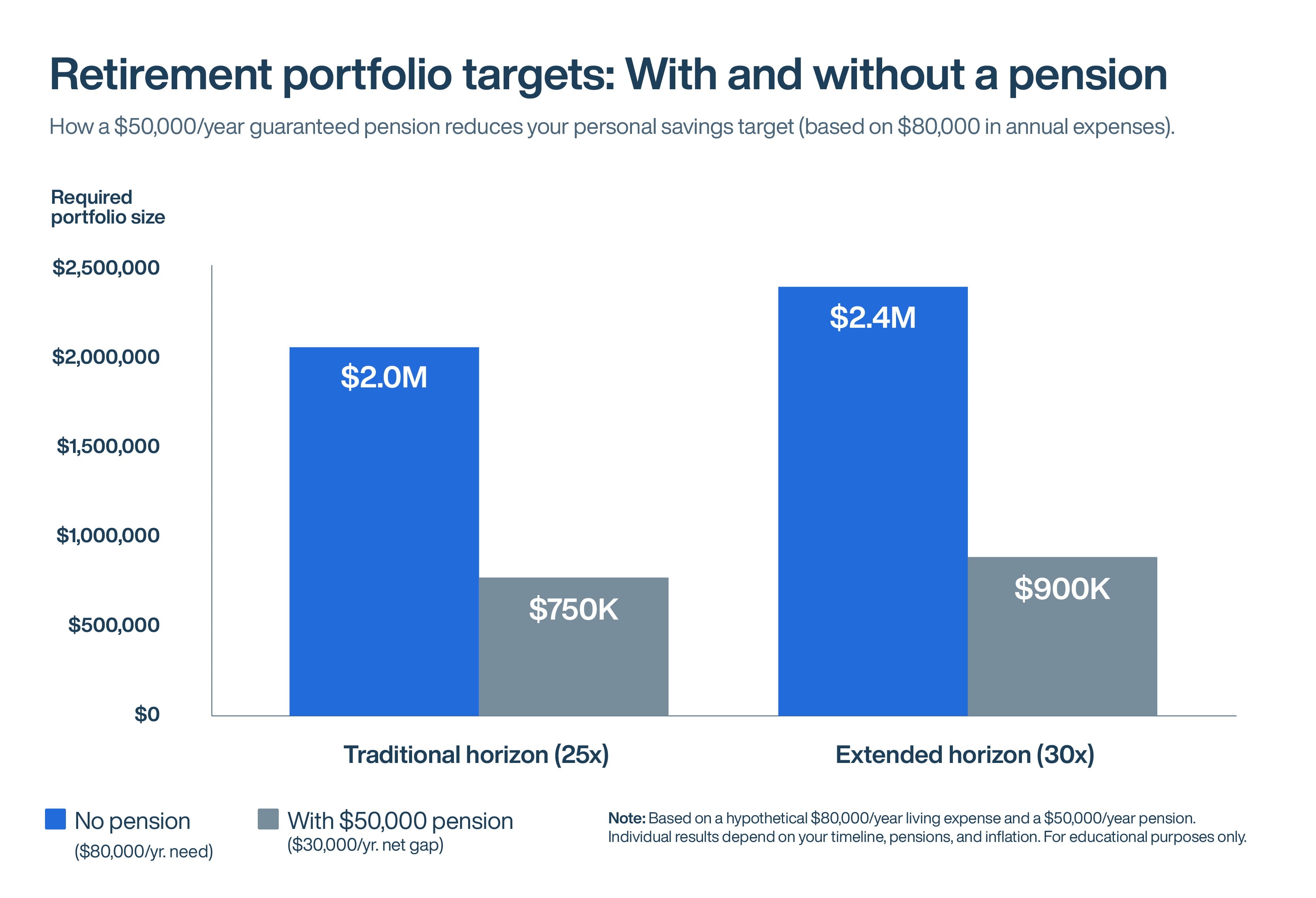
Remember that this calculation is purely a high-level gauge to help you measure progress. It does not replace a personalized retirement plan. Your personal savings goal will depend on your pension structure, national benefits, debt payoff timeline, currency needs, and individual tax considerations.
Connect your numbers to your broader life plan
Reaching a financial milestone is rewarding, but the numbers alone are only part of the journey. A successful retirement connects your financial resources to the life you want to live.
As you develop your retirement plan, take time to:
- Define what you want your days to look like.
- Review your numbers with a qualified financial advisor before making major career or portfolio decisions.
- Prepare yourself emotionally to shift from saving to spending.
How UNFCU can help
- Investment services: Explore third-party options through Copper Financial. Availability depends on location and eligibility. Written materials are in English. Review services and disclosures.
- Retirement FAQs: Find information about UNFCU membership, pension deposits, and account services in retirement. Review retirement FAQs.