

How to start saving for retirement

Retirement looks different from one person to another. For you, retirement could mean stopping work, working less, changing careers, or having enough money to have complete control over how you spend your time.
Workplace pensions, national retirement systems, and personal accounts can all play a role. While national retirement systems can replace a baseline of your income, their eligibility rules, qualifying ages, and payout amounts can change over time.
Building your own dedicated retirement savings, whether through a workplace or your own personal accounts, can bring you closer to your ideal future.
Set a starting contribution goal
You do not need a complete retirement plan before you begin saving for it. A small, regular contribution creates strong financial habits that give your money the opportunity to grow.
If you are unsure where to begin, start with a savings goal of 3% to 6% of your gross income (income that comes before taxes and other deductions). Employers can sometimes match contributions up to this amount, which immediately doubles your contribution and accelerates compounding growth.
This range is a suggested starting point, not a measure of whether you are saving enough. You can adjust your contributions as your goals and circumstances change.
Give your money time to grow
Starting to save early gives each contribution more time to grow through compounding. Compounding means you earn returns or dividends on both your contributions and those earnings. Saving early and often can yield more growth than saving larger amounts later in life.
For example,1 suppose two people each earn $60,000 a year. Person A starts saving 5% of their income at the age of 25. Person B starts saving at age 40 but saves twice as much. If both individuals earn a constant annual return of 7% on their savings each year, with no change in salary or contribution amount, by the time each person reaches age 65, Person A who started saving at 25 will have an estimated $598,905, and Person B will have an estimated $379,494 — roughly a $219,411 difference.
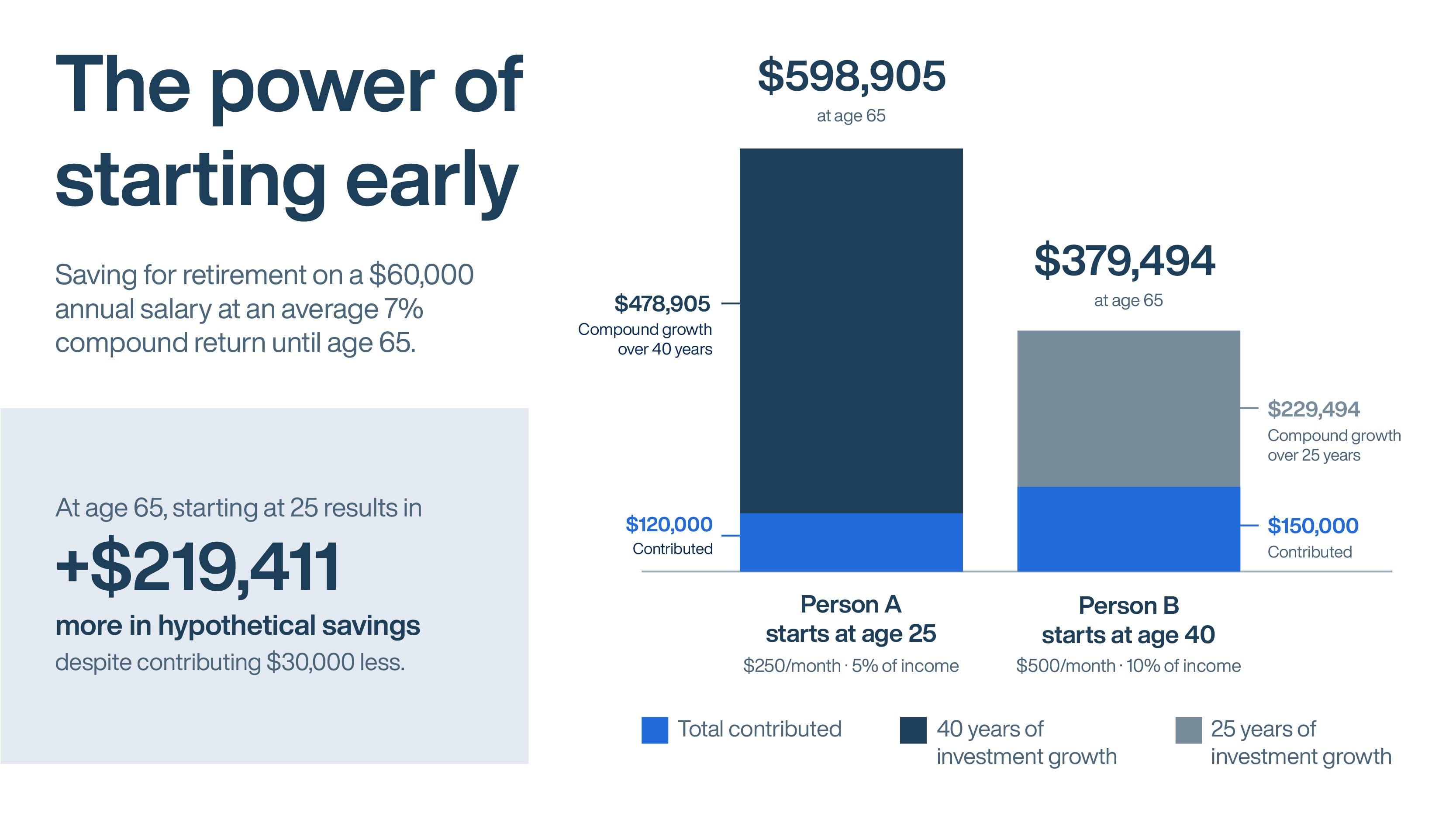
- This example assumes consistent deposits each month, a constant hypothetical annual rate of 7.00% compounded monthly, and no change in salary or contributions. It excludes fees, taxes, and withdrawals and does not account for inflation. The 7% rate of return is for illustration purposes only, not a specific account rate or guaranteed return.
Find out what you already have
Before opening new accounts, look at the arrangements connected to your current or past employment. Review your pay records, benefit statements, employment documents, and government or pension accounts. Ask your employer or plan provider:
- Am I currently enrolled in a retirement or pension plan?
- How much do I contribute?
- Does my employer contribute or match part of my contribution?
- When do employer contributions fully belong to me?
- What happens to the account if I change jobs or countries?
If an employer match is available, check how much you need to contribute to receive matching funds and whether that amount fits your budget. If there is no match or workplace plan, explore personal savings options available where you live.
Keep records from former and current employers and countries together so you can see the full picture.
Prioritize your future self
Saving for retirement means giving future needs a place alongside today’s responsibilities. To make retirement saving part of your routine, consider these savings habits:
- Automate a manageable amount: Pay yourself first by setting up a payroll contribution or recurring transfer where available. Leave enough for essential expenses and required payments.
- Increase gradually: After a pay raise or the end of a debt payment, consider directing a portion of that extra money toward retirement.
Choose where to keep your savings
The approach that fits you depends on when you may need the money, your country of residence, and your comfort with risk. Compare access rules, costs, and investment options before deciding.
If you need help, speak with a qualified financial professional familiar with the countries connected to your finances.
How UNFCU can help
- Investment services: Explore third-party options through Copper Financial. Availability depends on location and eligibility. Written materials are in English. Review services and disclosures.
- Share certificates: Compare term deposits for money you can leave untouched for a set period. Explore share certificates.
- Compound savings calculator: Estimate how much your savings could grow using your contribution amount, timeline, and assumed rate. Use the compound savings calculator.
- Payroll deposit: Work with your employer to direct part of each eligible salary payment to savings automatically. Set up payroll deposit or request UN payroll deduction.
- Automatic transfers: Schedule recurring transfers between your UNFCU deposit accounts through Digital Banking. Learn how to transfer between accounts.