How saving 20–25% can create your ideal retirement
Saving 20% to 25% of gross income is widely recognized as the standard for creating long-term wealth. However, reaching this savings percentage is not easy. It requires steady discipline, deliberate choices, and a commitment to prioritize your future.
If you are just beginning your financial journey, you do not need to start at 20% or 25% immediately. You can first learn how to start saving for retirement or explore how saving 10% to 15% strengthens your future. Once you have developed a strong retirement savings habit, building toward 20% to 25% can unlock more flexibility for your future goals.
Why save 20% to 25%?
Committing to this higher tier of savings is a personal decision based on what matters most to you. There are three primary reasons someone may choose to save this amount:
- Catching up on a late start: If you began setting money aside later in your career, saving at this pace can help make up for lost compounding growth time without forcing you to delay retirement.
- Retiring earlier than usual: Stepping away from full-time work in your fifties or early sixties requires a larger retirement fund accumulated over a compressed window.
- Funding an expanded lifestyle: Stopping full-time work gives you back many hours every week. For some, this extra freedom may require a retirement income that exceeds your current living expenses, allowing you to fund passion projects or extensive travel.
Defining your retirement vision
Deciding whether a 20% to 25% savings rate fits your life begins with defining your vision for retirement. What do you want your post-work years to look like?
Start with a simple estimation to understand what that freedom and flexibility may cost:
- Estimate your monthly lifestyle budget: Calculate what you realistically need each month to fund your desired lifestyle, including housing, healthcare, hobbies, and international travel.
- Determine your target annual expenses: Multiply that monthly figure by 12 to establish your baseline annual spending.
- Calculate your target savings number: Multiply your annual spending by the number of years you plan on being in retirement. This benchmark, based on a standard 3% to 4% sustainable annual withdrawal rate, gives you a practical estimate of what you may need.
While this provides a very rough estimate, before making significant shifts to your retirement strategies, discuss your numbers with a qualified financial advisor.
The power of compounding growth
Saving up to 25% fundamentally shifts the compounding equation. For example, consider an earner with a consistent $100,000 salary ($8,333 monthly) who saves 25% ($2,083/month) at a hypothetical 7% average annual return compounded monthly.
| Retirement scenario | Starting age (with $0 saved) | Target retirement age | Monthly savings (25%) | Projected balance at 7% growth | Potential retirement impact |
|---|---|---|---|---|---|
| Early | 25 | 53 (28 years) | $2,083 | $2.16M | Replaces roughly 85% of salary. |
| Flexible | 35 | 60 (25 years) | $2,083 | $1.69M | Replaces roughly 65% of salary on personal savings alone. |
| Catch-up | 47 | 67 (20 years) | $2,083 | $1.09M | Replaces up to 40% of income, creating a strong cushion alongside pensions. |
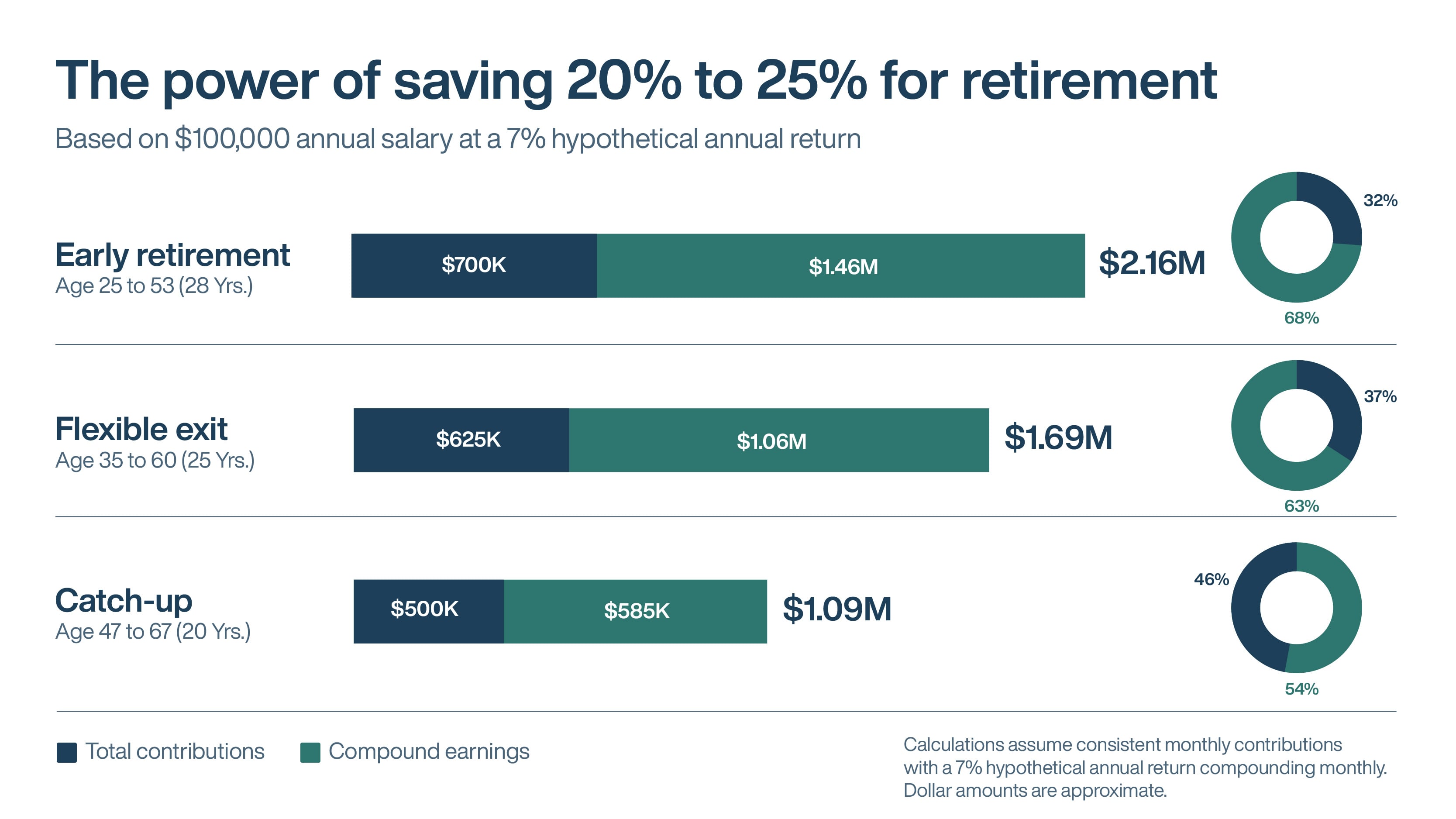
This example assumes deposits at the end of each month and a constant hypothetical 7% return compounded monthly. It excludes fees, taxes, and withdrawals and does not account for inflation. The 7% rate is for illustration only and is not a specific account rate or guaranteed return. All amounts are displayed in the same chosen currency.
Considerations for early retirement
If your goal is an early retirement, you may encounter a timing gap. Most national retirement programs and tax-advantaged employer pensions have minimum age rules, often imposing a penalty if money is withdrawn before a certain age, depending on the jurisdiction and organization.
This is where a bridge account can be useful. A bridge account is a flexible, taxable investment or dedicated savings account with no age-based withdrawal penalties. If you choose to retire from work early, your bridge account can fund your living expenses until your workplace pensions, national benefits, and other retirement accounts become accessible.
How UNFCU can help
- Investment services: Explore third-party options through Copper Financial. Availability depends on location and eligibility. Written materials are in English. Review services and disclosures.
- Share certificates: Compare term deposits for money you can leave untouched for a set period. Explore share certificates.
- Compound savings calculator: Estimate how much your savings could grow using your contribution amount, timeline, and assumed rate. Use the compound savings calculator.
- Payroll deposit: Work with your employer to direct part of each eligible salary payment to savings automatically. Set up payroll deposit or request UN payroll deduction.
- Automatic transfers: Schedule recurring transfers between your UNFCU accounts through Digital Banking. Learn how to transfer between accounts.
You may also be interested in
When a 7- to 12-month emergency savings reserve can be useful
Deciding when to pay off low-interest debt